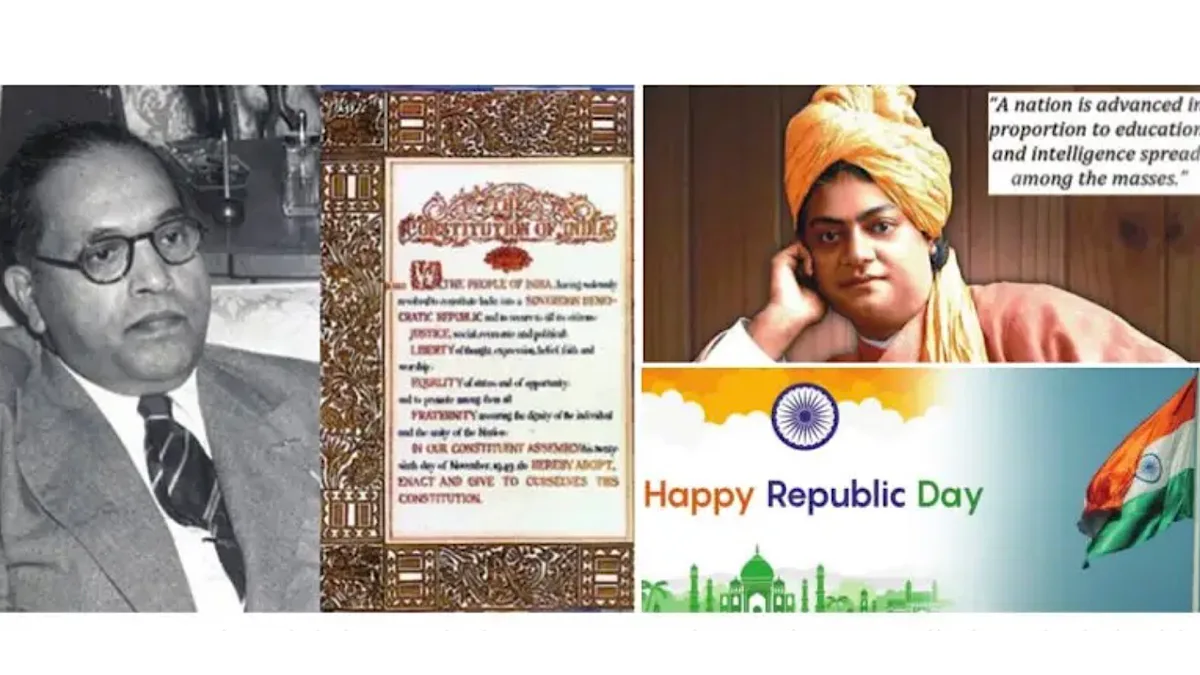
As the nation prepares to celebrate yet another Republic Day on 26th January, 2026, some serious reflections on the health of the republic are the need of the hour. While institutions and ideas forming the bedrock of our constitutional edifice are under intense scrutiny, it is also pertinent to reflect on the inner dynamics of ‘We, the People of India’ who enacted, adopted and gave to themselves the hallowed Constitution of India.
The quality of human resource is a very significant marker of a nation’s power which again depends on variables like access to nutrition, health care, education, and skill. Of equal importance are subjective factors like fellow feeling, cooperative spirit, ability for team work, empathy for the less privileged, respect for other’s rights, intolerance towards injustice and agency to fight for vindication of citizens’ rights. Dr. Bhimrao Ambedkar’s emphasis on the principle of Fraternity, as the most significant cohesive factor joining together the values of Liberty Equality and Justice, is particularly noteworthy as one tries to fathom the nuances of India’s nationhood.
Advertisement
At the beginning of its journey as the world’s largest democracy, 345 million people started a ‘tryst with destiny’, to borrow a phrase immortalized by India’s first Prime Minister Pandit Jawaharlal Nehru. It was a stupendous challenge for every Indian and the leaders as they embarked on a journey to lift millions above the poverty line, to ensure universal education, health care, and meaningful employment, and perhaps most daunting, to eradicate entrenched divisive factors like casteism, communalism , patriarchy, linguistic chauvinism and ethnic animosities so as to create a truly cohesive nation, a rock solid edifice of the “we, the people of India”.
During the last seven decades, the trajectory of India’s journey has been an awe-inspiring one. Proving wrong many Western scholars who predicted the imminent collapse of democracy in a semi-literate, underdeveloped country, India has muddled through, despite occasional hiccups. One of the world’s fastest growing economies, producing the highest numbers of graduates every year, a country whose technological prowess has become noteworthy, a country committed to uphold the post-war liberal international order, a leading advocate of sustainable, futuristic development, India has made its mark in the comity of nations. But unfortunately, the people of India, despite their glorious achievements in various fields, continue to be a divided lot.
Casteism, communalism, violence against women and people of third gender continue to tear asunder the fabric of our nation. Many social commentators allege that such violence, far from declining, is on the rise. These prejudices continue to lurk behind our gleaming cities, sparkling malls, spiraling highways, and our apparently peaceful, idyllic rural hinterland. Citizens for Justice and Peace has recorded thousands of cases of caste-related violence even in 2025, like the killing of Dalit men who dared to have relationships with upper caste girls, Dalit students denied access to drinking pots in schools, Dalit grooms burned alive for daring to ride a horse during marriage procession, a practice considered to be the prerogative of only upper caste men.
Though India has risen to rank 130 in the 2025 Human Development Index, showing progress in life expectancy, education, and income, it continues to face persistent gender, caste, communal and income inequality. Neeraj Ghaywan’s film ‘Homebound’, recently shortlisted for Best International Feature Film by the Oscar Awards Committee is a soul-stirring depiction of two young men, belonging to the marginalized sections of society, struggling desperately for a life of dignity in a ruthless society trying to hide its nasty prejudices. According to the renowned Indian economist and philosopher Amartya Sen, true freedom goes beyond merely having resources; it is about the ability to use these resources to lead the kind of life one values.
Prevalence of primordial prejudices in India often acts s a hindrance to economic and emotional wellbeing. India is witnessing a troubling rise in road rage incidents, with what often begins as a minor disagreement escalating into violent altercations, sometimes ending in death. Frustrations on the road, fuelled by congestion and impatience, are increasingly leading to physical confrontations. In extreme cases, these incidents have turned deadly, leaving behind a trail of victims. Extreme lack of patience and fellow feeling becomes apparent from such incidents. Numerous incidents of stampedes in India also reflects badly on our national character.
From religious festivals to sporting celebrations, fan frenzy to political campaigns, the year 2025 witnessed several crowd crushes and stampedes, leading to over 100 deaths. While what triggered these stampedes could vary, poor crowd management and a lack of proper public infrastructure cannot be ignored. Almost 80 per cent of stampedes in India occur at religious gatherings or pilgrimages. They also bear testimony to the fact that Indians keen on achieving salvation often sacrifice the basic human spirit of helping the weaker among us on the altar of blind devotion, not only to Gods and Goddess but also cine superstars and renowned footballers. Women and children suffer greater number of casualties in such incidents.
People becoming irrational machines of wild passion, and dispensers of justice, lynching petty thieves sometimes accused of stealing food are symptomatic of deep-seated anger or frustration, perhaps rising from dissatisfaction about their own socio-economic conditions or helplessness in the face of mounting corruption and abuse of power perpetrated by the social and political elite. Our leaders are projected and accepted as Messiahs, not evaluated as duty bound public servants. Psychologists opine that rapid degeneration of moral and ethical standards and ever-increasing materialistic cravings, exacerbated by a rabid bourgeoise and consumer culture, are contributing to the emergence of a heartless, cruel social order.
Our education is no longer a man-making mission but just a tool to open the gates of material success. Men are becoming money-making machines. Of late, the rate of suicides has risen alarmingly in India, particularly among young men, women and even among the elderly. Suicides in India have quietly become a public health emergency. Multiple factors are responsible for this growing malady. Adolescents and young children often struggle with academic challenges or neglectful or abusive parenting, while many older adults grapple with social isolation and coming to terms with physical limitations. Sheer hopelessness and lack of social support push them into the pit of depression.
Breakdown in relationship and financial crisis emerging from wrong choices are also pertinent factors. The trend signifies weakening of our emotional resilience, fighting spirit and our helplessness and isolation in an era when people have numerous friends in social media but very few in real life, friends who can hold one’s hands and offer advice in times of crisis. India ranked 118th out of 147 countries in the World Happiness Report 2025 released recently, again a pointer to the sorry state of the mental well-being of Indians. This Republic Day, we should pay more attention to this sorry state of affairs and focus on taking care of our emotional intelligence alongside material wellbeing. We must recall the clarion call of Swami Vivekananda, asking us to stand by our less fortunate brethren. Let us find strength in each other’s wellbeing and thus make ‘Viksit Bharat’ a truly ‘Manvik (Humane) Bharat’.
(The writer is an Associate Professor in the Department of Political Science, Women’s Christian College, Kolkata)